
Brief history of the production of the Porsche 356
; (incl. IVA 21%)
Availability: Immediate
The first Porsche 356 rolled off the production line in Stuttgart in 1950. Production lasted until 1965, when production ceased, by which time more than 76,000 examples of various model designations had been produced.
It was Porsche’s first production vehicle, with an evolution beginning with the 356 now known as Pre-A, the 356A introduced in 1955, the 356B in late 1959, and the final series 356C introduced for the 1964 model year. In each version, were predominantly built as Coupé or Cabriolets. Karmann-bodied Notchback coupes and convertibles (1961-62) are especially sought after now, as is the limited production ‘Carrera’ four-cam racing version introduced in 1954.
The 356 was created by Ferdinand ‘Ferry’ Porsche (son of Ferdinand Porsche, founder of the company). In 1972, during an interview for PCA magazine, he summarized his thinking behind the concept as follows: “I had always driven very fast cars. He had an Alfa Romeo, also a BMW, and others… At the end of the war, he had a Volkswagen Cabriolet with a supercharged engine, and that was the basic idea. I saw that if you have enough power in a small car, it is better to drive it than if you have a big car that also has power. And it’s more fun. “With this basic idea we started the first Porsche prototype.”
This lightweight approach quickly gained popularity for the 356 and, combined with its power-to-weight ratio, rear-engine layout, agile handling and excellent build quality, gave the 356 suitable driver appeal, a proven formula that also provided a class win. Le Mans en 1951. Powers varied between 44 hp for the original 1131 cc engine and 130 hp for the later versions of the 1966 cc Carrera.
The 356 Pre-A or “prototype” built in Austria had aluminum bodies, but when manufacturing moved to Germany, Porsche hired Reutter to manufacture the bodies in steel and eventually bought the company in 1963. Reutter retained the sector seat manufacturing business. but later changed its name to Recaro, forming the company we are much more familiar with today.
In October 1964, the 356’s successor, the iconic 911, made its debut, but its enduring popularity ensured that production continued well into 1965.
You may also like…
Related products
-

Bumper horn with cut-out for tail pipe, rear, left for Porsche 356 B/C. By Dansk
372,92 €; (incl. IVA 21%) Add to cart -


Exhaust rear, Sport, with two polished stainless steel tail pipes in Carrera style for Porsche 356 B/C. By Dansk
655,78 €; (incl. IVA 21%) Add to cart -
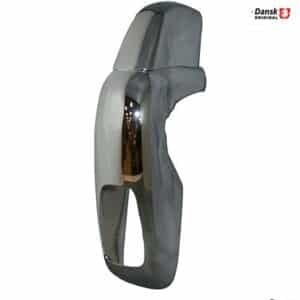
Bumper horn with cut-out for tail pipe, rear, right for Porsche 356 B/C. By Dansk
372,92 €; (incl. IVA 21%) Add to cart -

Mirror cromed, “AERO” model, exterior left / right sides for Porsche 356 (1955-59). By Dansk
31,93 €; (incl. IVA 21%) Add to cart